

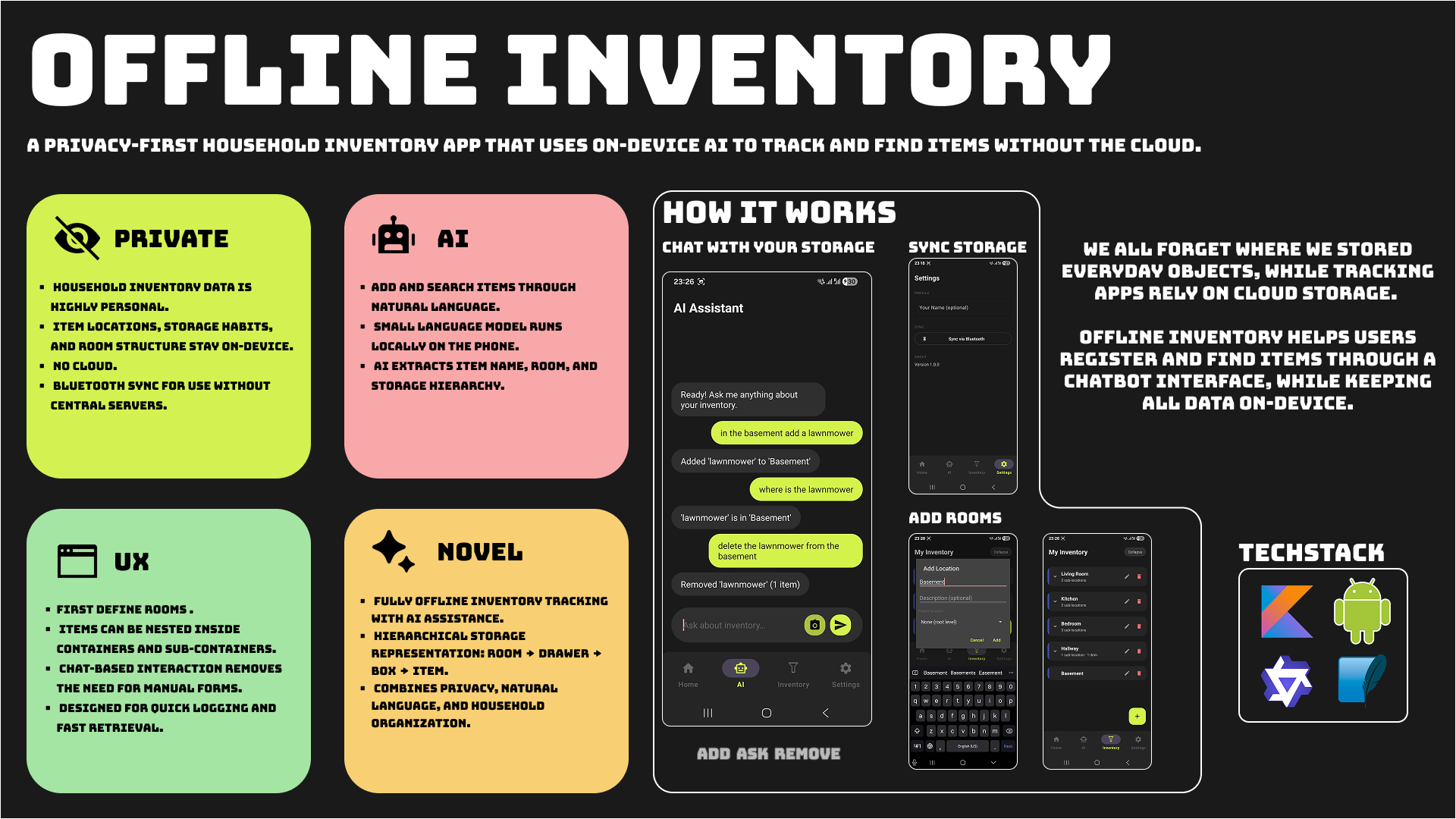
Modern households accumulate large quantities of personal belongings stored across multiple rooms, floors, and compartments. Over time, the precise locations of infrequently used items become difficult to recall, resulting in significant time lost to searching. This problem is compounded in households with complex storage layouts spanning attics, basements, and multiple floors. Existing digital inventory solutions fail to address this problem due to three main reasons. First, most rely on cloud services for storage and require active internet connectivity. Second, they require structured manual input through rigid forms which creates high friction that discourages consistent use. Third, they lack natural language capabilities forcing users to adapt to the system rather than the system adapting to the user. This project directly addresses these gaps by developing a privacy-focused, fully offline Android application that allows users to log household items and their pinpoint storage locations and retrieve that exact information through a natural language conversational chatbot interface. All data processing and storage are handled locally on the device. No data is transmitted externally at any point.
The CS Design Project module is one of the two final modules of the Bachelor. In the design component of this module, students show that they master the entire design trajectory, from the first informal specification of requirements by a client to the delivery and presentation of a well-documented working product. Projects are submitted by clients from either inside or outside the University. Students perform the project in groups of 3-5 students under the supervision of a teacher from the Department of Computer Science. The supervisor is also the one who assesses the process and products of the group. Project deliverables include a project proposal, a design report, a presentation and a poster.
View the full design report for this project.
Modern households accumulate large quantities of personal belongings stored across multiple rooms, floors, and compartments. Over time, the precise locations of infrequently used items become difficult to recall, resulting in significant time lost to searching. This problem is compounded in households with complex storage layouts spanning attics, basements, and multiple floors. Existing digital inventory solutions fail to address this problem due to three main reasons. First, most rely on cloud services for storage and require active internet connectivity. Second, they require structured manual input through rigid forms which creates high friction that discourages consistent use. Third, they lack natural language capabilities forcing users to adapt to the system rather than the system adapting to the user. This project directly addresses these gaps by developing a privacy-focused, fully offline Android application that allows users to log household items and their pinpoint storage locations and retrieve that exact information through a natural language conversational chatbot interface. All data processing and storage are handled locally on the device. No data is transmitted externally at any point.
The CS Design Project module is one of the two final modules of the Bachelor. In the design component of this module, students show that they master the entire design trajectory, from the first informal specification of requirements by a client to the delivery and presentation of a well-documented working product. Projects are submitted by clients from either inside or outside the University. Students perform the project in groups of 3-5 students under the supervision of a teacher from the Department of Computer Science. The supervisor is also the one who assesses the process and products of the group. Project deliverables include a project proposal, a design report, a presentation and a poster.
View the full design report for this project.