

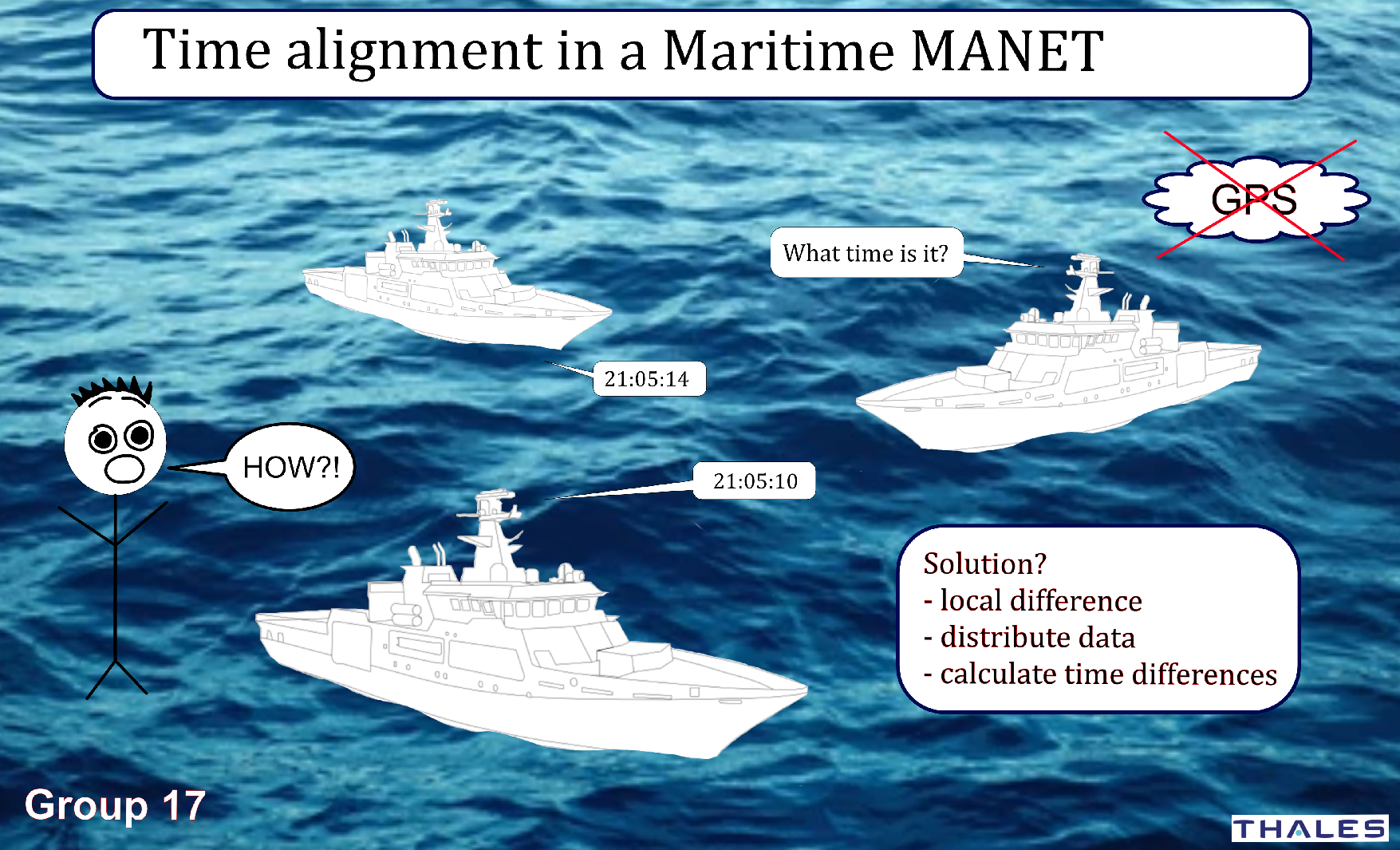
When ships are working in groups, information exchange over a wireless network is of great importance. This network is a mobile ad-hoc network, called a MANET. The fusion of exchanged observations is dependent on time alignment to make sure that every node in the network can get a complete picture from the different observations. One of the ways to align nodes in time is through the use of GPS. However, this is not always possible. In these cases, nodes in a group instead need to have relative time alignment with each other. For this problem, time differences with neighbouring nodes have to be measured. Then, the information that was measured needs to be shared with other nodes. Lastly, all received information should be fused to obtain the time difference between any pair of nodes. To implement and test these principles, all of this has to run on an existing virtualized simulator.
The CS Design Project module is one of the two final modules of the Bachelor. In the design component of this module, students show that they master the entire design trajectory, from the first informal specification of requirements by a client to the delivery and presentation of a well-documented working product. Projects are submitted by clients from either inside or outside the University. Students perform the project in groups of 3-5 students under the supervision of a teacher from the Department of Computer Science. The supervisor is also the one who assesses the process and products of the group. Project deliverables include a project proposal, a design report, a presentation and a poster.
The design report for the module.
View the full design report for this project.
When ships are working in groups, information exchange over a wireless network is of great importance. This network is a mobile ad-hoc network, called a MANET. The fusion of exchanged observations is dependent on time alignment to make sure that every node in the network can get a complete picture from the different observations. One of the ways to align nodes in time is through the use of GPS. However, this is not always possible. In these cases, nodes in a group instead need to have relative time alignment with each other. For this problem, time differences with neighbouring nodes have to be measured. Then, the information that was measured needs to be shared with other nodes. Lastly, all received information should be fused to obtain the time difference between any pair of nodes. To implement and test these principles, all of this has to run on an existing virtualized simulator.
The CS Design Project module is one of the two final modules of the Bachelor. In the design component of this module, students show that they master the entire design trajectory, from the first informal specification of requirements by a client to the delivery and presentation of a well-documented working product. Projects are submitted by clients from either inside or outside the University. Students perform the project in groups of 3-5 students under the supervision of a teacher from the Department of Computer Science. The supervisor is also the one who assesses the process and products of the group. Project deliverables include a project proposal, a design report, a presentation and a poster.
The design report for the module.
View the full design report for this project.