

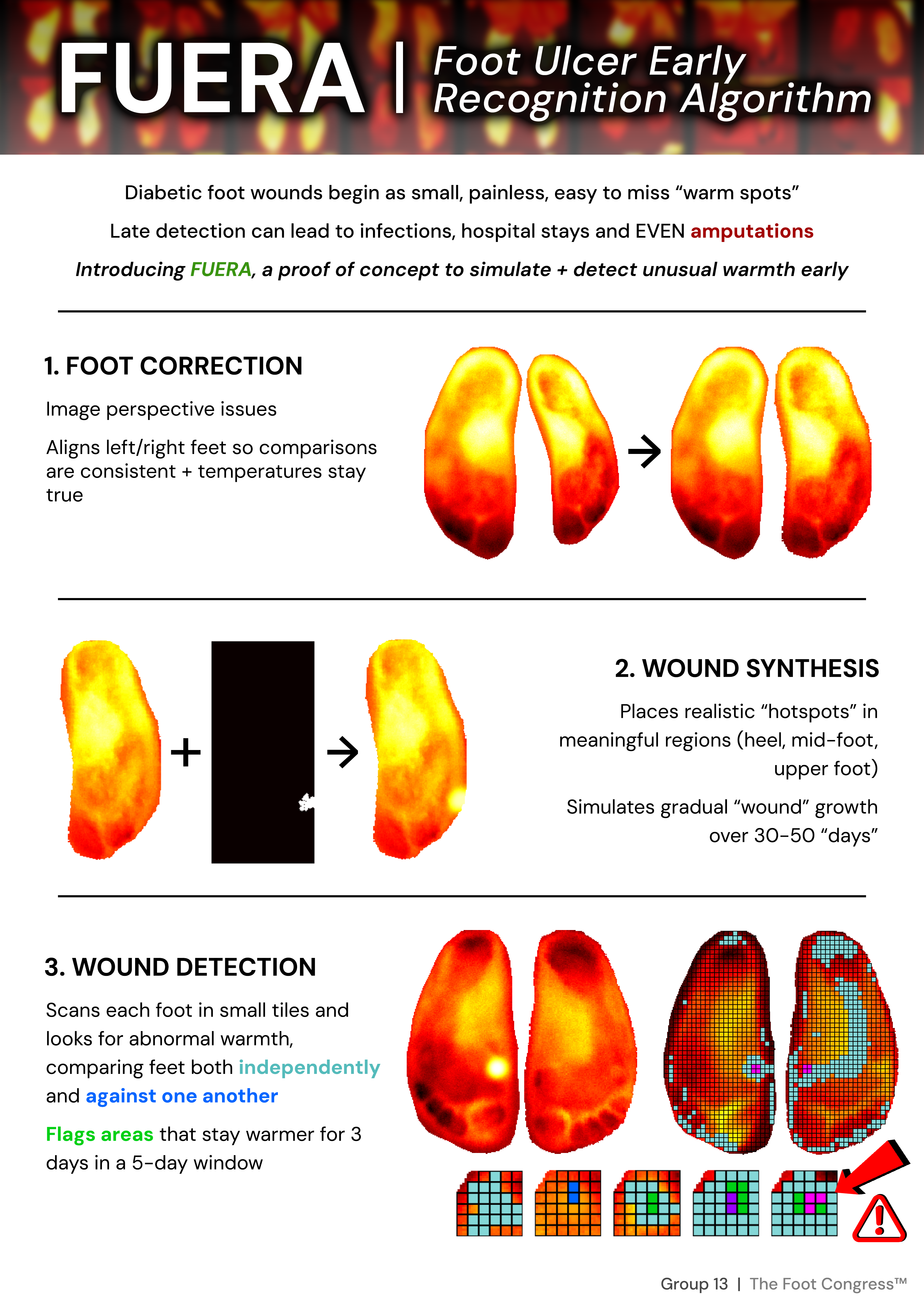
Diabetes affects over 100 million people worldwide, with about 34% developing diabetic foot ulcers (DFUs) caused by neuropathy and repetitive stress. These ulcers often lead to immobility, require extensive care, and result in amputation in 25% of cases, with a 40% recurrence rate within a year. To address this, ZGT Hengelo Hospital in the Netherlands aims to develop an Early Diabetic Foot Ulcer Detection system using a thermal camera bath mat to monitor daily foot temperatures and identify early signs of DFUs. Since long-term data on developing ulcers is scarce, the task was to also generate synthetic thermal images from existing datasets of healthy and ulcerated feet. Using this data, the Foot Ulcer Early Recognition Algorithm (FUERA) was developed to detect early-stage DFUs by analyzing temperature differences across and within feet, enabling early intervention and reducing hospital burden and patient healthcare costs.
The CS Design Project module is one of the two final modules of the Bachelor. In the design component of this module, students show that they master the entire design trajectory, from the first informal specification of requirements by a client to the delivery and presentation of a well-documented working product. Projects are submitted by clients from either inside or outside the University. Students perform the project in groups of 3-5 students under the supervision of a teacher from the Department of Computer Science. The supervisor is also the one who assesses the process and products of the group. Project deliverables include a project proposal, a design report, a presentation and a poster.
This is the final presentation that was used in presenting during the last meetings with the supervisors and the client.
View the full design report for this project.
Diabetes affects over 100 million people worldwide, with about 34% developing diabetic foot ulcers (DFUs) caused by neuropathy and repetitive stress. These ulcers often lead to immobility, require extensive care, and result in amputation in 25% of cases, with a 40% recurrence rate within a year. To address this, ZGT Hengelo Hospital in the Netherlands aims to develop an Early Diabetic Foot Ulcer Detection system using a thermal camera bath mat to monitor daily foot temperatures and identify early signs of DFUs. Since long-term data on developing ulcers is scarce, the task was to also generate synthetic thermal images from existing datasets of healthy and ulcerated feet. Using this data, the Foot Ulcer Early Recognition Algorithm (FUERA) was developed to detect early-stage DFUs by analyzing temperature differences across and within feet, enabling early intervention and reducing hospital burden and patient healthcare costs.
The CS Design Project module is one of the two final modules of the Bachelor. In the design component of this module, students show that they master the entire design trajectory, from the first informal specification of requirements by a client to the delivery and presentation of a well-documented working product. Projects are submitted by clients from either inside or outside the University. Students perform the project in groups of 3-5 students under the supervision of a teacher from the Department of Computer Science. The supervisor is also the one who assesses the process and products of the group. Project deliverables include a project proposal, a design report, a presentation and a poster.
This is the final presentation that was used in presenting during the last meetings with the supervisors and the client.
View the full design report for this project.