

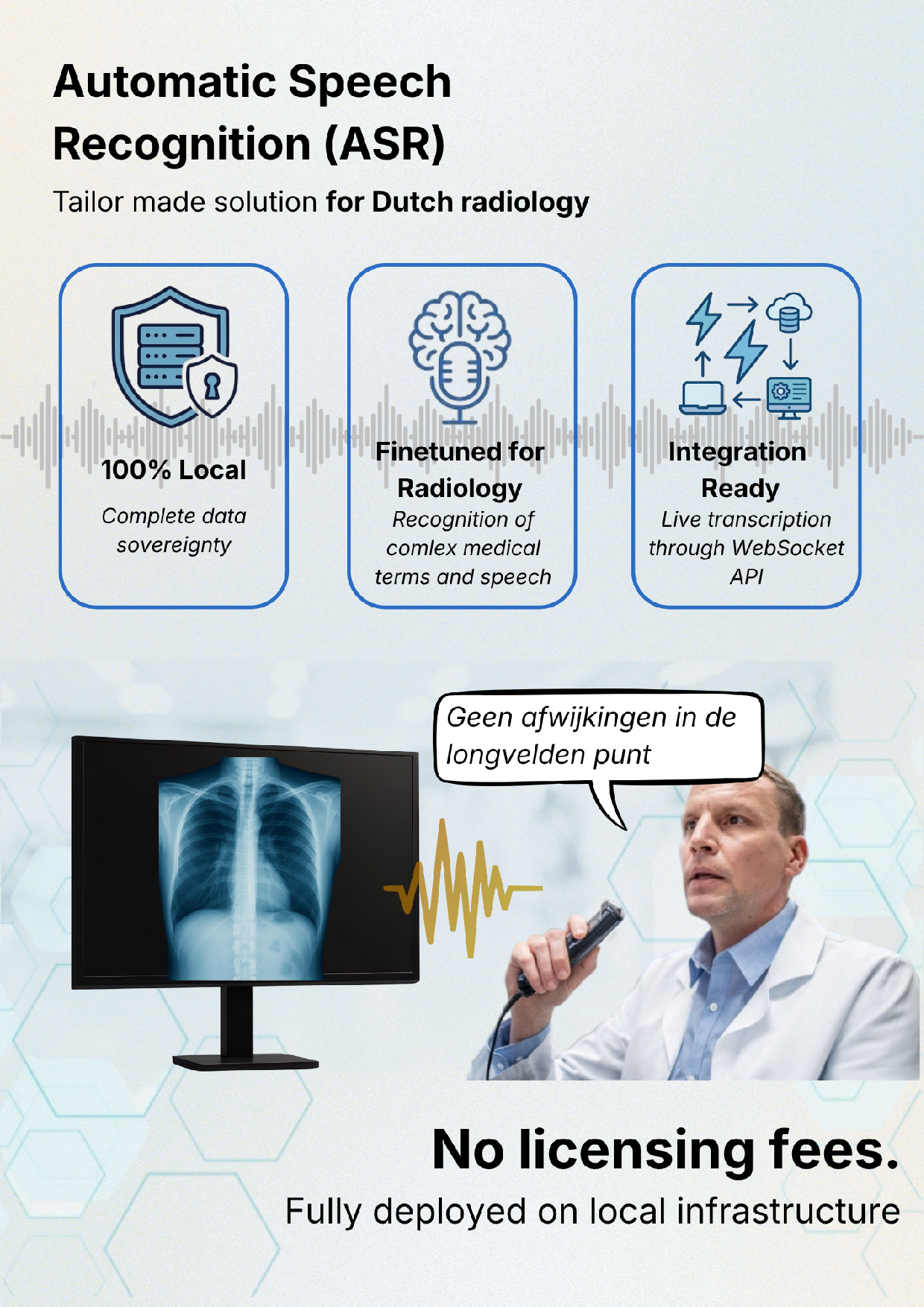
This project developed an open-source, on-premises Automatic Speech Recognition prototype for radiologic dictations at Hospital Group Twente, replacing a costly proprietary system while ensuring GDPR compliance. After benchmarking models including Whisper and NVIDIA's Canary, NVIDIA's Parakeet-TDT-0.6b was selected for its strong performance on Dutch medical terminology and inference speed. Fine-tuning on 13 hours of radiology dictations achieved a Word Error Rate of 15.5% and Character Error Rate of 7.0%, with the final system featuring real-time transcription, manual correction, and a feedback loop for continuous improvement. The result is a scalable framework that can be extended to other medical departments without reliance on third-party cloud services.
The CS Design Project module is one of the two final modules of the Bachelor. In the design component of this module, students show that they master the entire design trajectory, from the first informal specification of requirements by a client to the delivery and presentation of a well-documented working product. Projects are submitted by clients from either inside or outside the University. Students perform the project in groups of 3-5 students under the supervision of a teacher from the Department of Computer Science. The supervisor is also the one who assesses the process and products of the group. Project deliverables include a project proposal, a design report, a presentation and a poster.
This project developed an open-source, on-premises Automatic Speech Recognition prototype for radiologic dictations at Hospital Group Twente, replacing a costly proprietary system while ensuring GDPR compliance. After benchmarking models including Whisper and NVIDIA's Canary, NVIDIA's Parakeet-TDT-0.6b was selected for its strong performance on Dutch medical terminology and inference speed. Fine-tuning on 13 hours of radiology dictations achieved a Word Error Rate of 15.5% and Character Error Rate of 7.0%, with the final system featuring real-time transcription, manual correction, and a feedback loop for continuous improvement. The result is a scalable framework that can be extended to other medical departments without reliance on third-party cloud services.
View the full design report for this project.
This project developed an open-source, on-premises Automatic Speech Recognition prototype for radiologic dictations at Hospital Group Twente, replacing a costly proprietary system while ensuring GDPR compliance. After benchmarking models including Whisper and NVIDIA's Canary, NVIDIA's Parakeet-TDT-0.6b was selected for its strong performance on Dutch medical terminology and inference speed. Fine-tuning on 13 hours of radiology dictations achieved a Word Error Rate of 15.5% and Character Error Rate of 7.0%, with the final system featuring real-time transcription, manual correction, and a feedback loop for continuous improvement. The result is a scalable framework that can be extended to other medical departments without reliance on third-party cloud services.
The CS Design Project module is one of the two final modules of the Bachelor. In the design component of this module, students show that they master the entire design trajectory, from the first informal specification of requirements by a client to the delivery and presentation of a well-documented working product. Projects are submitted by clients from either inside or outside the University. Students perform the project in groups of 3-5 students under the supervision of a teacher from the Department of Computer Science. The supervisor is also the one who assesses the process and products of the group. Project deliverables include a project proposal, a design report, a presentation and a poster.
This project developed an open-source, on-premises Automatic Speech Recognition prototype for radiologic dictations at Hospital Group Twente, replacing a costly proprietary system while ensuring GDPR compliance. After benchmarking models including Whisper and NVIDIA's Canary, NVIDIA's Parakeet-TDT-0.6b was selected for its strong performance on Dutch medical terminology and inference speed. Fine-tuning on 13 hours of radiology dictations achieved a Word Error Rate of 15.5% and Character Error Rate of 7.0%, with the final system featuring real-time transcription, manual correction, and a feedback loop for continuous improvement. The result is a scalable framework that can be extended to other medical departments without reliance on third-party cloud services.
View the full design report for this project.